Get in touch
I'm always excited to take on new projects and collaborate with innovative minds.
Phone
Email
Website
I'm always excited to take on new projects and collaborate with innovative minds.
Autonomous systems are rapidly moving from single-unit operations to collective intelligence. My recent research into Secure Autonomous Drone Swarms has led me to explore one of the most significant challenges in robotics: maintaining perfect coordination in unpredictable, GPS-denied environments.
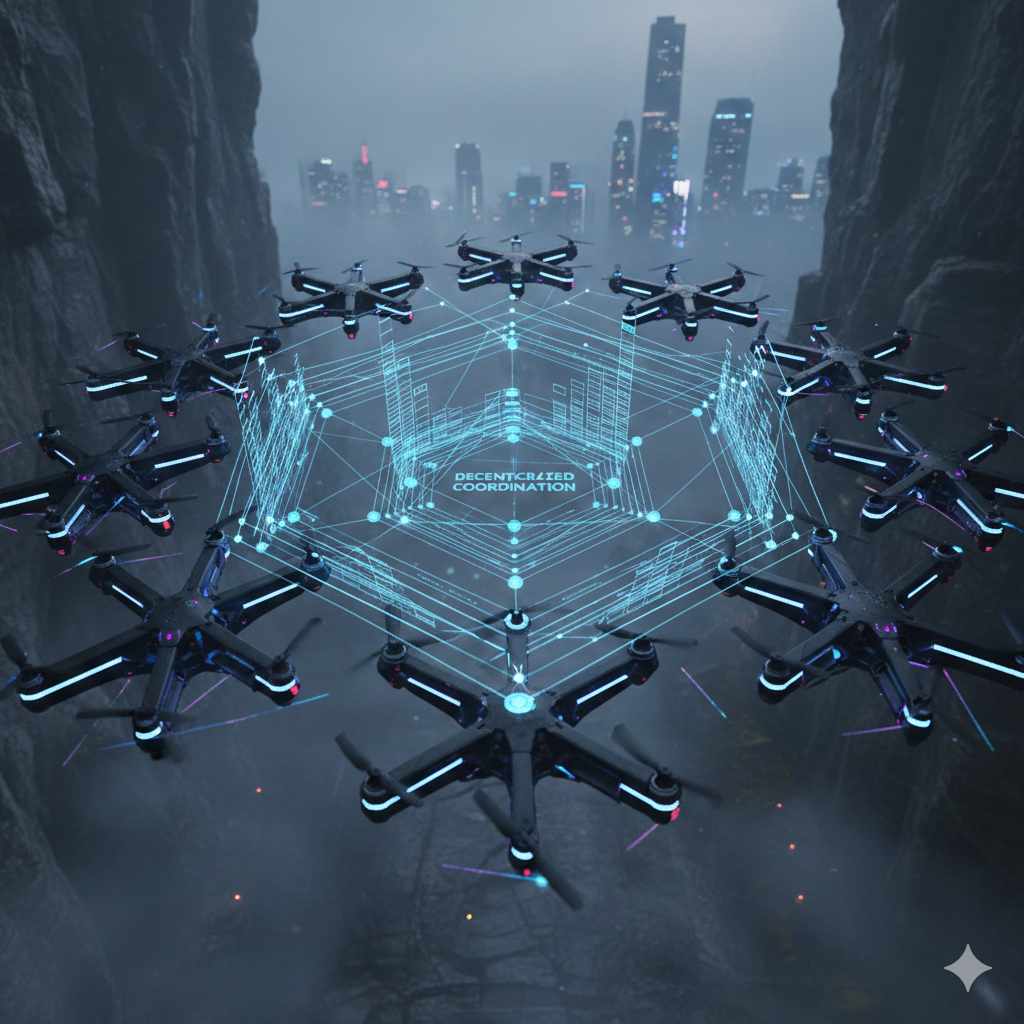
Remember when a single drone flying over a landscape felt like science fiction? Those days are already behind us. Today, the real frontier isn't about one drone it's about hundreds of them, working together as a single intelligent organism.
I've spent the last several months immersed in a question that keeps robotics researchers up at night: How do we keep a drone swarm perfectly coordinated when everything goes wrong?
Not "perfect weather" wrong. Not "strong GPS signal" wrong. I'm talking about the real world deep canyons where satellites can't reach, indoor warehouses with no signals, or environments where someone is actively trying to jam communications.
My recent research, which culminated in my paper "Decentralized Coordination and Acoustic Localization in Secure Autonomous Drone Swarms," explores exactly this challenge. And honestly? The findings have me more excited about the future of autonomous systems than I've been in years.
Let me walk you through what I discovered and why I believe we're on the verge of something transformative.
Here's the uncomfortable truth about most drone swarms today: they're secretly reliant on infrastructure we can't control.
We design these beautiful algorithms for swarm behavior, assuming every drone knows exactly where it is in the world. But that "knowing" usually comes from one place: GPS. And GPS has a fatal flaw it stops working when we need it most.
Consider these scenarios:
A search-and-rescue team deploys a drone swarm into a collapsed building. No GPS.
A delivery fleet navigates between skyscrapers in a dense city. GPS multipath errors everywhere.
An emergency response swarm operates in a disaster zone where communications are jammed. No external signals at all.
In all these cases, traditional swarms fail. They lose formation. They become disoriented. They stop being useful exactly when lives depend on them.
This isn't just a technical problem it's a trust problem. If we can't guarantee that autonomous systems will work when infrastructure fails, we'll never fully integrate them into our emergency response, logistics, or smart city infrastructure.
So how do we fix it?
My research focused on two fundamental shifts in how we think about drone swarms. Together, they create something genuinely new.
Most drone swarms today operate like a puppet show. There's a puppeteer a ground station, a lead drone, a central computer and everyone else follows orders. It's tidy. It's predictable. And it's fragile.
If that central node goes down, the entire swarm falls out of the sky.
Decentralized architecture flips this model entirely.
In a decentralized swarm, every drone is its own boss. There's no leader. There's no single point of failure. Instead, each drone talks to its immediate neighbors, shares information, and makes local decisions based on what it sees and hears.
Think of it like a flock of starlings. No single bird is directing the murmuration. Each bird follows simple rules stay close to your neighbors, match their speed, avoid collisions and the beautiful, complex behavior emerges naturally.
The resilience this creates is extraordinary:
One drone fails? The rest reconfigure around the gap.
Communications get patchy? Drones work with whatever neighbors they can reach.
Need to scale from 10 drones to 100? No problem you're not overloading a central computer.
Decentralization means the swarm isn't just smart it's survivable.
Okay, so the drones are making their own decisions. That's great. But they still need to know where they are relative to each other. If GPS is unavailable, how do they do it?
This is where things get really interesting.
My research explores acoustic-based positioning essentially, having drones "talk" to each other using sound.
Here's how it works:
Each drone emits a unique acoustic signal think of it as a chirp, but encoded with identifying information.
Neighboring drones listen for these chirps. By measuring how long the sound takes to arrive, they calculate exactly how far away the other drone is.
Combine multiple distance measurements, and a drone can triangulate its precise position relative to the rest of the swarm.
The entire formation maintains itself using only these relative positions no GPS required.
Why sound? Because sound works where radio fails. Acoustic signals:
Penetrate indoor environments where GPS can't reach
Work in deep canyons and urban valleys
Are incredibly difficult to jam without creating obvious noise
Require no external infrastructure whatsoever
Imagine a swarm of drones navigating through a dark, smoke-filled warehouse during a fire emergency. They can't see. They can't get GPS. But they can hear each other and that's enough to maintain perfect formation and guide first responders.
That's not theoretical. That's what this technology enables.
Now, here's the part that keeps me up at night in a good way.
If we're going to deploy these swarms for critical missions delivering medicine, coordinating emergency response, monitoring infrastructure we need to ensure they can't be hacked, spoofed, or hijacked.
A swarm that loses GPS is resilient. A swarm that gets hijacked by a bad actor is dangerous.
This is why security can't be an afterthought.
My research emphasizes a "security-first" approach, which means:
Every acoustic signal is authenticated. Drones verify that the chirp they're hearing is really coming from a trusted teammate, not an impersonator.
Telemetry data is encrypted end-to-end. Even if someone intercepts the communication, they can't read it or tamper with it.
The swarm monitors itself for anomalies. If one drone starts behaving strangely maybe it's been compromised the others can identify the threat and isolate it.
The goal is simple: tamper-proof coordination. We're building swarms that not only work when infrastructure fails, but actively protect themselves against those who would exploit that failure.
This isn't abstract research. These capabilities have direct, practical applications that I find genuinely thrilling.
Emergency Response
Imagine a chemical spill in an industrial facility. It's too dangerous to send humans in immediately. A drone swarm navigating by sound, coordinating without central control maps the site in real-time, identifies hazards, and guides subsequent response teams. No GPS required. No vulnerable external signals.
Next-Generation Logistics
Delivery drones navigating dense urban environments face constant GPS challenges. Skyscrapers block signals. Multipath reflections cause errors. With acoustic localization, swarms maintain precise formation regardless of the urban canyon. They know exactly where they are relative to each other, ensuring safe, efficient delivery corridors.
Critical Infrastructure Inspection
Inspecting pipelines, power lines, or bridges often takes drones into areas with poor connectivity under bridges, inside tunnels, through remote canyons. A decentralized, acoustically-aware swarm continues operating seamlessly, sharing inspection data and maintaining coverage even when individual drones lose contact with the outside world.
Defense and Security
In contested environments where GPS jamming is expected, this technology ensures that swarms remain operational. They become effectively immune to the most common forms of electronic warfare not through heavier armor, but through smarter design.
As we build toward a future of smart cities and ubiquitous automation, one question will determine success or failure:
How much can we trust these systems?
Trust isn't built on perfect conditions. It's built on resilience on knowing that when things go wrong, when signals fail, when environments turn hostile, the autonomous systems we've deployed will keep working.
The synergy between swarm intelligence (how groups make decisions) and cybersecurity (how we protect those decisions) is where this trust is forged.
Swarm intelligence gives us adaptability and resilience.
Cybersecurity gives us integrity and protection.
Together, they give us systems worthy of the missions we'll ask them to perform.
I'm deeply excited about where this is heading. My current and future work focuses on several extensions of this research:
Multi-modal sensing: Combining acoustic localization with visual data and other sensors for even more robust positioning in challenging environments.
Distributed learning: Enabling swarms to collectively learn from their experiences and adapt their behavior over time.
Human-swarm interaction: Developing intuitive ways for human operators to interface with and direct decentralized swarms during critical missions.
If any of this resonates with you whether you're a fellow researcher, an engineer building autonomous systems, or just someone fascinated by where robotics is heading I'd love to connect.
Let's Build the Future Together
The transition from single drones to collective intelligence isn't just an incremental improvement. It's a fundamental shift in what autonomous systems can achieve.
But realizing that potential requires solving hard problems problems of coordination, navigation, security, and trust. My research tackles these challenges head-on, and I'm always looking for collaborators, conversation partners, and fellow travelers on this journey.
Check out my full research trajectory and projects on my profile. If you're working in #Robotics, #UAVs, #AutonomousSystems, or any related field, reach out. Let's push this technology forward together.
The future of autonomous systems is collective, resilient, and secure. I can't wait to build it with you.
Your email address will not be published. Required fields are marked *
-1.png)