Chat
Shahanur Islam Shagor
The Modern Backend Trifecta: Choosing the Right Tool for the Right Task
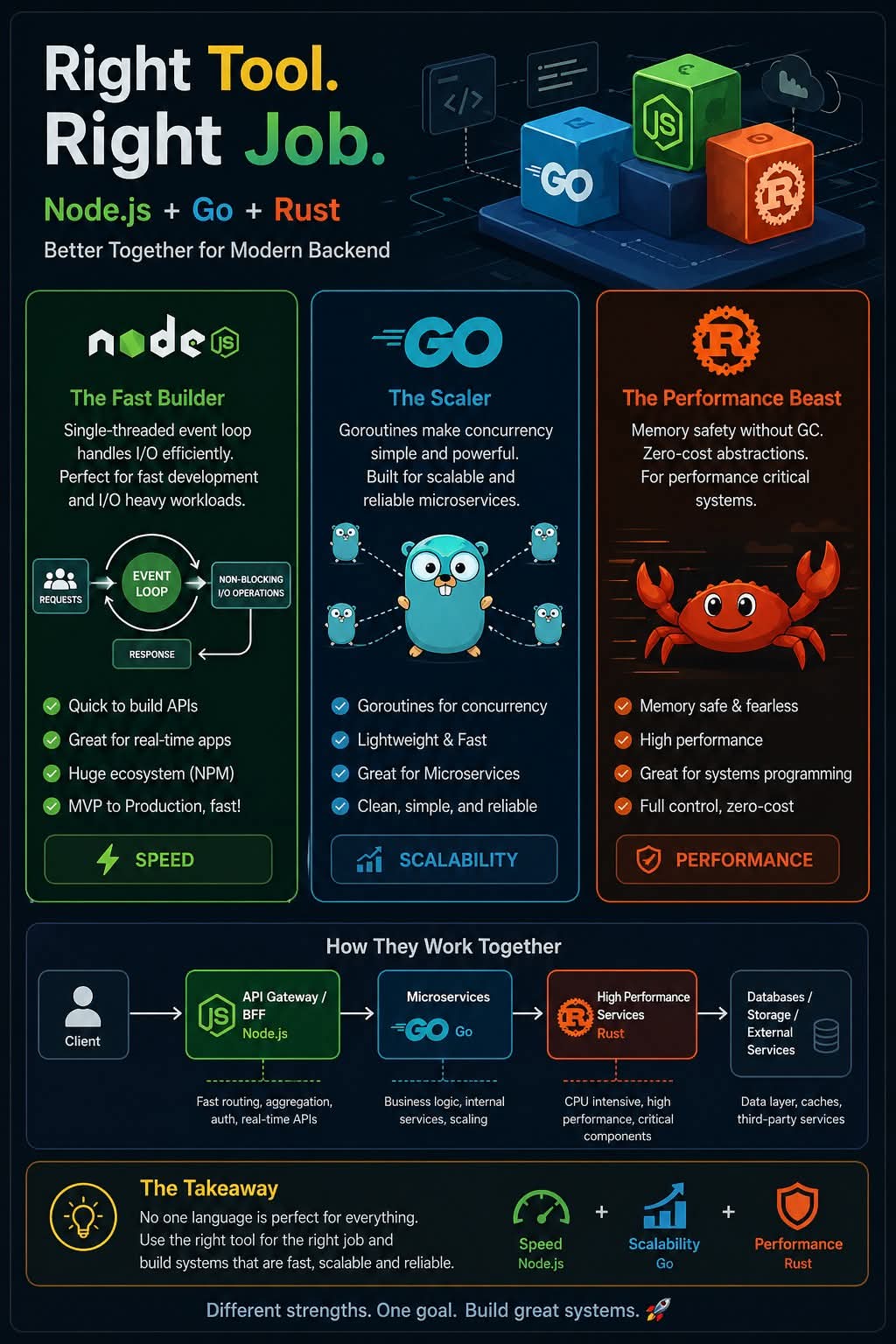
In modern software engineering, the language is just a lever. My backend philosophy has shifted from mastering a single tool to mastering the ecosystem. By leveraging Node.js for rapid API development, Go for robust microservice orchestration, and Rust for performance-critical bottlenecks, I build systems that are not just functional, but mathematically optimized for their specific workload.
Article Details
Structured for reading, reference, and practical implementation takeaways
This article view follows the same polished long-form layout style as the other detail pages, while keeping the reading area focused and the supporting context easy to scan.
Backend development isn’t about committing to a single language anymore—it’s about making smart decisions based on the problem in front of you. In modern systems, speed, scalability, and performance don’t come from one tool alone, they come from combining the right ones. For web-focused work, Node.js lets you move fast and ship features quickly. As systems grow, Go brings structure, concurrency, and reliability for scalable microservices. And when performance truly matters, Rust gives you deep control over memory and efficiency at a level others can’t match. What this really means is backend engineering has evolved into a strategic discipline—where understanding when and where to use each technology matters more than mastering just one.
I now understand one thing clearly about backend — the era of solving everything with a single language is over.
I used to think “I have to learn Node.js” or “Go is best” — but after getting into a real project, I realized that changing the tool according to the problem is a smarter approach.
Node.js is still the fastest way for me to build something
New features, APIs, MVPs — can be built very quickly.
It is absolutely smooth for I/O heavy work.
Using Go gives me a different confidence
Handling concurrency is simple, the code is clean,
It is very practical to build microservices.
After learning Rust, I realized — it is on another level
Performance, memory control, safety — everything can be handled at a deep level.
But it also takes more effort, there is no shortcut.
My mindset now is:
To build something fast → Node.js
To build scalable services → Go
In performance critical areas → Rust
The most important thing —
Backend does not mean a single language,
Backend means a smart combination.
I am slowly trying to apply this mix to my microservice system.
Article Discussion
Comments and replies
Leave a Comment
Join the discussion
Article Discussion
Comments and replies
Leave a Comment